
How the Forks Became the Village of Midland
- Midland History
- Origins of Midland
Origins of Midland, Part 2
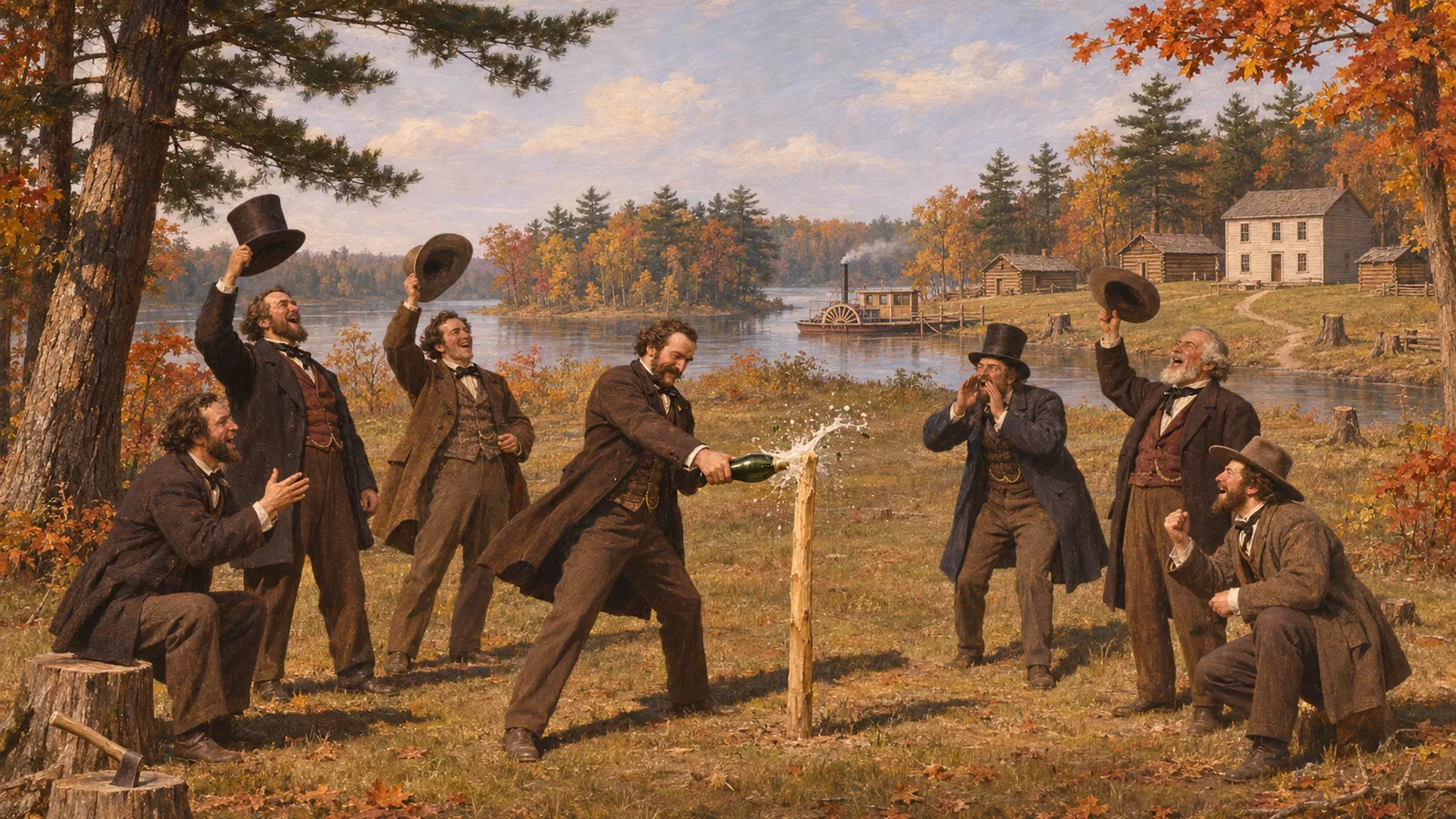
Walk onto the courthouse lawn on West Main Street and stand near the front steps. In October 1856 a group of men came to this spot to drive a stake into the ground. That stake decided where Midland County would keep its government, and it shaped where Midland itself would grow. According to the county’s 1884 history, the Saginaw party came upriver by steamer with a basket of champagne, Billy Vance broke the first bottle over the stake, and the whole company got “gloriously full.”
There wasn’t much here yet to celebrate. When the county seat was chosen, Midland City had about fifteen households. It took thirteen more years, a newspaper, two steamboats, and a railroad before Midland became a legal village in 1869. Part 1 of this series ended with the 1837 treaty that sold the Little Forks reserve. Part 2 picks up there. It draws on the sources closest to the events. The main one is the 1884 Portrait and Biographical Album of Midland County, written while many of the founders were still alive. Others include Truman Fox’s 1868 History of the Saginaw Valley, state historical markers, census returns, railroad records, and the Midland historians who came later. Some of the best stories survive in only one source. When that’s the case, I say so.
A Few Families at the Forks (1837 to 1850)
John Wyman came up the river from Saginaw in February 1837 and moved into a log cabin near the junction of the rivers. Charles Fitzhugh, who had bought a large tract around the Forks, built it. On July 6, 1837, Wyman’s daughter Julia was born in that cabin, the first child born to a settler family in what became Midland County. She was still living in Midland City in 1884. The cabin stood on ground that later became the county fairgrounds.
The record disagrees on which settler came first. The 1884 history calls John A. Whitman the first settler who came to stay and dates his arrival to 1836. The same book’s biography of Whitman puts him in Ingersoll Township in 1844, and Wyman’s 1875 obituary says no other white settler lived in the county when Wyman arrived. Fur traders had kept a post near the Forks since about 1831, as Part 1 described. The weight of the record makes the Wymans the first documented settler family there.
For more than a decade the settlement barely grew. For several years fewer than half a dozen settler families lived in the whole county. They girdled trees, cleared brush, planted potatoes, and hunted. There were no roads, so everything moved by water. Wheat went down to Saginaw by canoe, and flour, groceries, and dry goods came back. Later, Dan Osborne ran a seven-ton pole boat to Saginaw three times a week. The settlers’ nearest neighbors were Ojibwe families who still lived along both rivers. The county’s first meeting house was a Methodist mission about a mile south of the village, built for the Ojibwe families on the south bank, where the minister preached through an interpreter.
In 1838, state geologist Douglass Houghton started drilling for salt brine on the Tittabawassee near the mouth of the Salt River, close to present-day Sanford. The drill stuck at about 140 feet, and the state gave up in 1842. That brine later mattered more to Midland than the pine did.
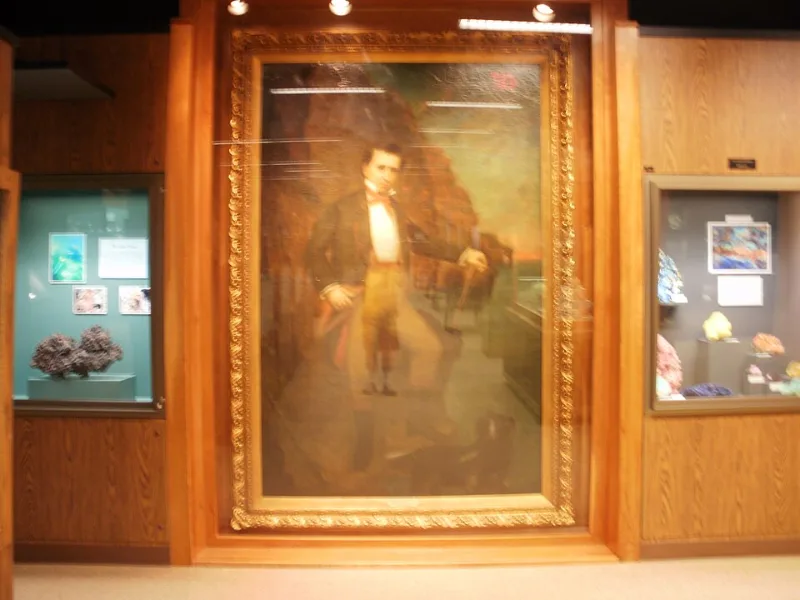

The 1850 census counted 65 people in Midland County.
A County on Paper (1850 to 1855)
Midland County’s boundaries were drawn in 1831, and it took its name from its spot near the center of the Lower Peninsula. The Legislature organized the county by an act of March 29, 1850, but no officers were elected, and Midland stayed attached to Saginaw County for government. A second act, on February 8, 1855, finally called an election.
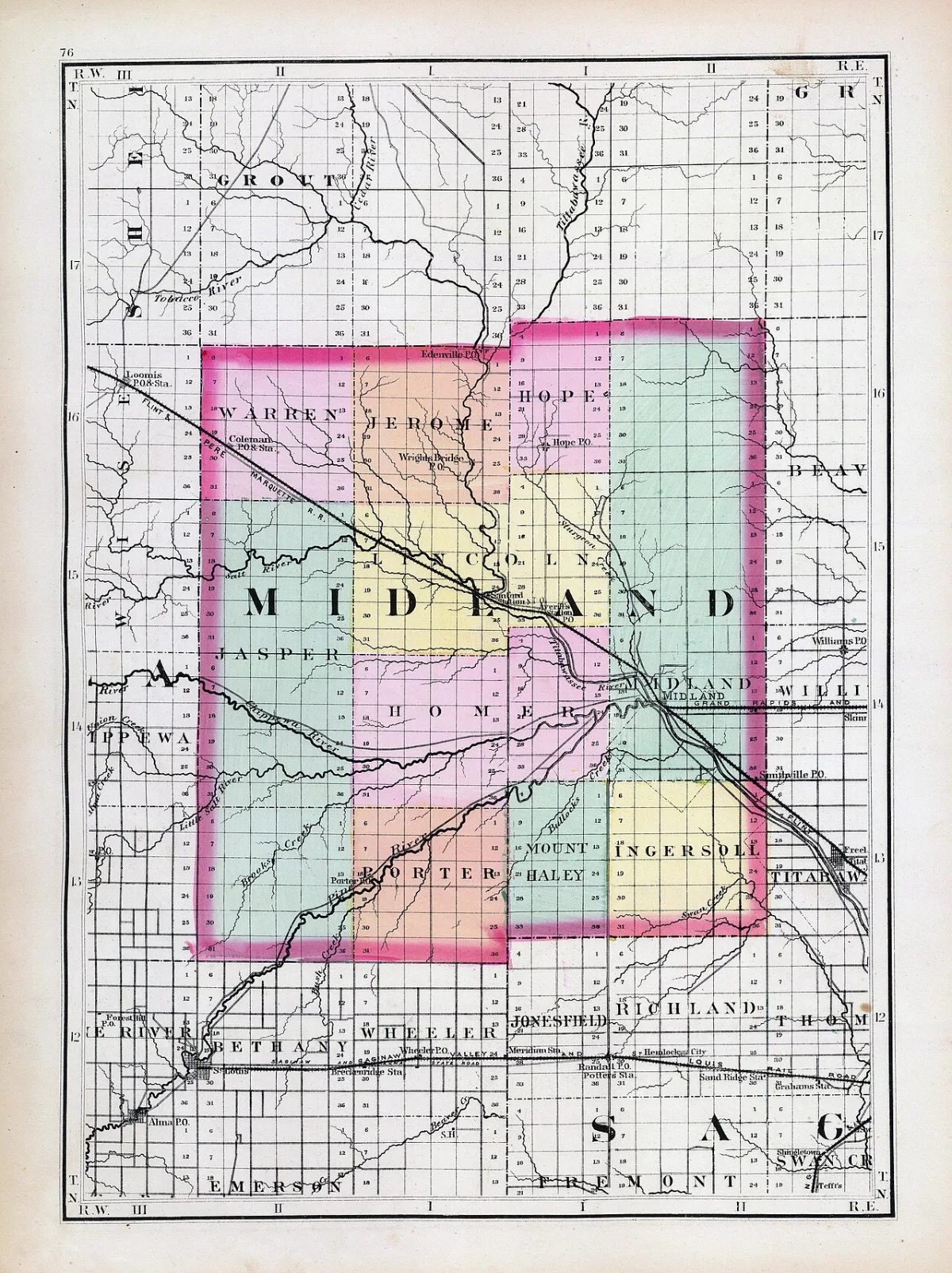

The 1884 history says that first county election drew fewer than two dozen votes. Voters chose G. W. Whiting as sheriff, Dr. Edwin P. Jennings as clerk, Henry C. Ashmun as prosecuting attorney, John A. Whitman as treasurer, Samuel Gaskill as probate judge, and George Turner as surveyor. The Board of Supervisors met for the first time on August 13, 1855, with Ashmun as chairman.
The earliest county records show how closely settler and Ojibwe lives still overlapped. The county paid an $8 bounty for each wolf. The first bounties, paid in January 1856, went to two settlers and five Ojibwe hunters.
Henry Ashmun Drives the Stake (1856)
Part 1 introduced Henry C. Ashmun, the son of fur trader Samuel Ashmun and an Ojibwe mother. He is the reason the courthouse sits where it does. Michigan’s legislator records list him as Midland County’s member of the state House in the 1855 and 1857 sessions. He persuaded the Legislature to let the Board of Supervisors and the prosecuting attorney choose the county seat. Ashmun chaired the first and held the second job himself.
The 1884 history says a Bay City man offered Ashmun $4,000 to drive the stake on his land, and Ashmun turned him down. The site was fixed on October 13, 1856, on the ground where the courthouse still stands, and the champagne party followed. Whether the land came from Fitzhugh or belonged to Ashmun is still an open question.
The county voted $6,000 for a courthouse. Timothy Jerome, a Saginaw lumber agent, drew the plans and built it, and county officers moved into the frame building in 1858. Until then they had worked out of John Larkin’s house. That first courthouse served until 1926, when the present courthouse with its murals took its place.
The courthouse opened and the town’s first newspaper started printing in 1858. Midland became a legal village eleven years later, in 1869.
Main Street Begins (1855 to 1860)
In 1855 the future Midland City was still a lumber camp known as the Forks. The 1884 history describes a lumber shanty and stables on the site of today’s city cemetery, owned by the lumber firm of the Copelands, Ripley and Stewart, with Timothy Jerome as agent.
John Larkin changed that. Alvin Marsh built the first frame building in Midland City for Larkin in 1855. Larkin’s hotel opened in 1856, and the county history says Larkin also served as the first postmaster, keeping the mail in a three-foot cupboard in the hotel bar room. The mail came up from Saginaw once a week.
Other firsts followed close behind. James Eastman opened a store near the dock, which was then the center of town. Samuel Sias built a grist mill. In October 1857 the county paid $150 for a ferry scow across the Tittabawassee on the state road toward Isabella County. A crossing cost 3 cents on foot, 6 cents with a single team, and 10 cents with a double team. The ferry became free in 1858. The Methodist “Midland” circuit, organized in September 1857, was the town’s first religious organization, and its first class book listed 13 people. Mrs. Flanders taught the first village school in 1859, at Ashmun and Ellsworth streets, and the county’s first circuit court met in the same schoolhouse.
The county’s first sawmill went up in 1858 on Snake Creek, about three miles north, built by Capt. Philo Sumner and a partner named Snyder. Larkin bought it and moved it to Midland. By 1884 his firm, Larkin & Patrick, was the village’s largest employer.
In April 1858 Nathan T. Carr started the Midland Sentinel, the county’s first newspaper. The county history says he renamed it the Midland City Sentinel “when the proposition to organize this village was made.” The Library of Michigan holds issues of the Midland City Sentinel from 1864, so the town was calling itself Midland City, and talking about becoming a village, years before it was one. The paper changed owners and names several times in the 1860s, and by 1868 it was the Midland Independent.
The River Town
Before the railroad, the Tittabawassee was Midland’s highway. Larkin and Capt. Philo Sumner built a 25-ton side-wheel steamer named the Midland City to make three trips a week to Saginaw. It drew too much water when the river ran low, so the owners sold it and bought the Belle Seymour, which drew 18 inches empty and ran from 1860 until the railroad came. Both boats are known only from the 1884 history.
In 1868, Truman Fox wrote that small steamboats could run up the Tittabawassee as far as Midland City, which he called “a flourishing village,” and he listed John Larkin among the valley’s salt and lumber manufacturers. Fox wrote to draw investors and settlers, so his praise is period promotion. He also wrote it a year before Midland was a village in law.
Pine paid for all of it. Logging camps worked the Forks and upriver at a place called “Sixteen,” today’s Edenville. Across Michigan, lumber was the leading industry outside farming from about 1860 to 1910.
The Ojibwe Move to Isabella County (1855 to 1865)
While Main Street took shape, the Ojibwe families who had lived at the Forks long before Wyman were moving to the Isabella reservation under treaty terms and settlement pressure. The 1855 treaty at Detroit withdrew federal land in six Isabella County townships so that eligible Ojibwe families could select their own parcels, and it promised schools, a mill, a blacksmith, and an agent. After 1855, bands in the Pine River country and elsewhere were encouraged to move to Isabella County, and freight for the reservation moved up the Chippewa or along a trail on the river’s north side from Midland. The treaty’s federal support ended in 1865. The 1884 history records that the last Ojibwe families left Midland County that same year, though some came back in summer to pick huckleberries.
Part 1 covered what the Isabella years meant for the Saginaw Chippewa. For Midland, 1865 marks the end of a long stretch when Ojibwe and settler families lived side by side at the Forks. Their descendants are the Saginaw Chippewa Indian Tribe of Michigan, centered today in Isabella County.
The Railroad Arrives (December 1, 1867)
The Flint and Pere Marquette was chartered on January 22, 1857, to build from Flint across the state to Lake Michigan at Pere Marquette, today’s Ludington. Regular train service on the roughly 20 miles between East Saginaw and Midland began on December 1, 1867. The 1884 history says Midland residents offered inducements to bring the line and that John Larkin gave the right of way through the village. The tracks reached Averill the next year, Clare in 1870, and Ludington in 1874.
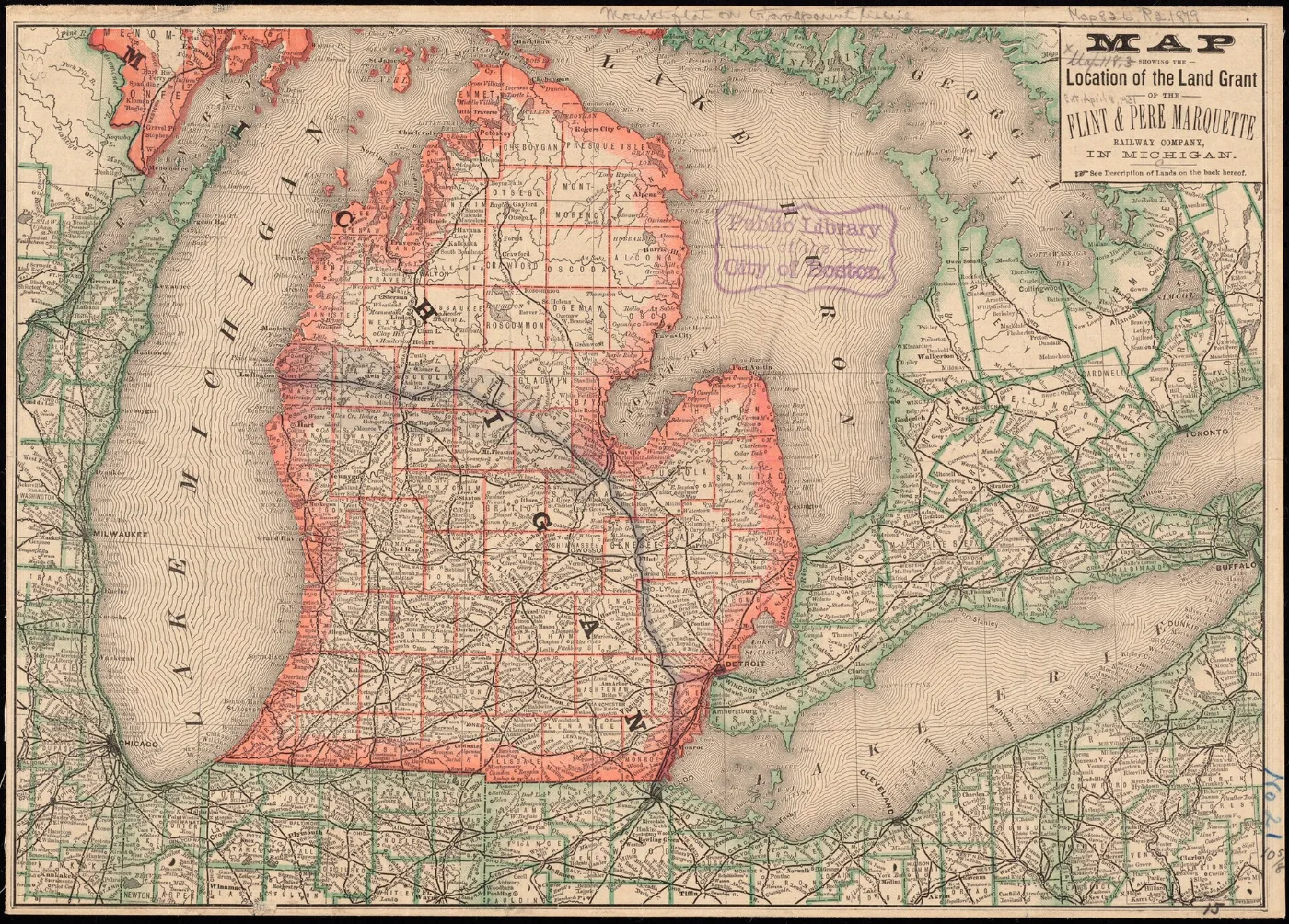

The railroad ended the steamboat years and changed the size of the place. Midland County grew from 787 people in 1860 to 3,285 in 1870, about four times larger in ten years.
The Village of Midland (1869)
Midland incorporated as a village in 1869. The first village election was held on April 19, 1869. Voters chose Solomon Heald as president, William Cressey as clerk, William Sinclair as treasurer, and H. M. Ellsworth as marshal. Each of the three wards sent two trustees: L. Church and T. A. Dorr, A. Findlater and J. W. Anderson, and Harvey Lyon and C. C. Ball. The new board met for the first time on April 26. Michigan Railroad History and Encyclopaedia Britannica both give 1869 for the village and 1887 for the city.
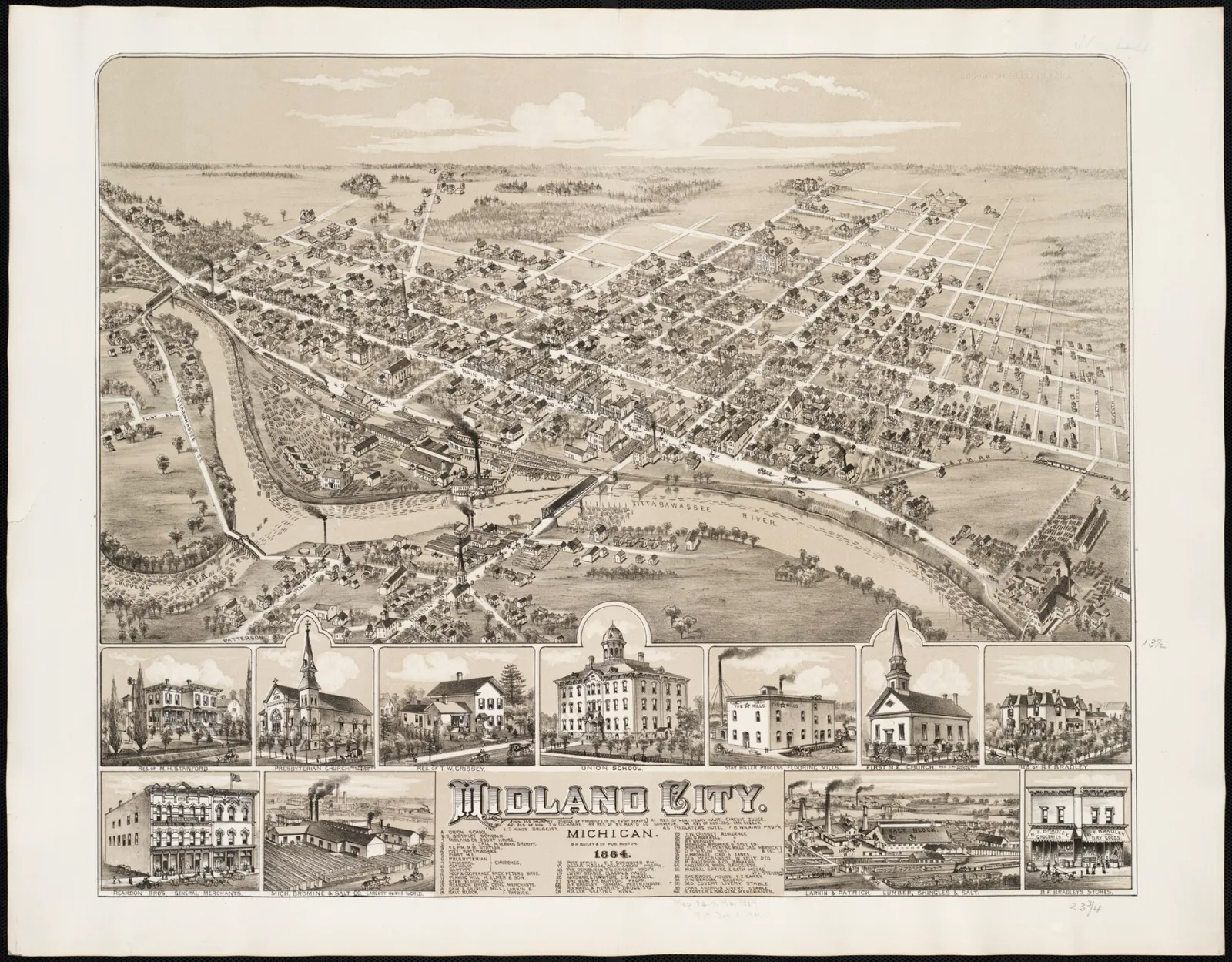

Look at that list and you’ll see names from every part of this story. Ellsworth helped drive the courthouse stake in 1856. Harvey Lyon, a Mexican War veteran, had drilled Midland’s home military company during the Civil War. Thirteen years after the champagne, the men who built the town finally had a government of their own.
What Came Next
The village had hard years ahead. The county history records that on May 27, 1876, sparks from a locomotive started a fire that burned 52 houses. Two years later Larkin & Patrick sank the village’s first brine well, and Houghton’s old idea came back to Midland. The city charter followed in 1887, and in 1890 Herbert Dow started a company here to pull bromine from that same brine.
Part 3 covers Midland’s lumber and salt years. If your family has an old photo of Main Street or a story passed down from those days, send it to me.