
Renovate or Move? How Midland Homeowners Can Compare a HELOC Addition With Buying a Bigger Home
- Selling Your Home
- Buying a Home
- Real Estate Education

If your house no longer fits how you live, you have two main ways to fix it. You can build the space you need, or you can go find it in another home. If you hold a mortgage rate near 3%, giving it up raises the cost of moving, and that changes pretty much everything.
Nationally, balances on home equity lines of credit (HELOCs) rose $23 billion in the third quarter of 2026, to $481 billion, according to the New York Fed’s Q3 2026 household debt report. The New York Fed calls it the largest quarterly increase it has observed since 2005 and the 18th straight quarterly gain (full report, PDF).
That $23 billion is the net change in what borrowers owe: new draws minus repayments. Total HELOC credit limits rose $31 billion, a figure that includes open lines with nothing drawn. Neither number is a count of new accounts. The report covers the whole country and tracks dollars only, with no data on why households borrowed, what they spent it on, or Midland itself.
Here is how to test the stay-and-borrow option against a move with your own numbers.
Step 1: Name the problem you need to solve
An addition can add a bedroom, a bigger kitchen, or a main-floor suite. Your commute, lot size, street, and the setbacks that limit how far you can build all stay the same. Before you price anything, answer three questions:
- Can the lot hold the addition under zoning setbacks and lot-coverage limits?
- Can the floor plan connect new space cleanly, or does it create a maze?
- Will this layout still work for your household five to ten years from now?
If any answer is no, you’ll probably want to start pricing a move. Confirm permit and zoning requirements with the City of Midland or your township building office before you pay for plans.
Step 2: How a HELOC works
A HELOC is a line of credit secured by your home. According to the CFPB, you can borrow up to your limit during a draw period (the CFPB uses 10 years as an example). After that you enter a repayment period, often 10 or 20 years, when you can no longer borrow. Most HELOCs carry a variable rate, so the payment can change month to month.
Some plans let you pay only interest during the draw. The CFPB warns that payments are often significantly higher once repayment begins, and some plans require the full balance at that point. A lender can also freeze your line if your home’s value drops, and if you can’t repay, you could lose your home. The CFPB’s HELOC booklet walks through shopping and comparing offers.
On rates: the prime rate, which many HELOCs follow, stood at 7.00% in early November 2026 (Federal Reserve data via FRED). Bankrate’s national average HELOC rate was 7.47% as of November 18, 2026, based on a $30,000 line from its survey of the 10 largest banks and thrifts in 10 large markets (Bankrate). Your quote will differ. Ask whether an advertised rate is introductory, which index it follows (often prime), and what margin the lender adds. The margin is a fixed amount added to the index.
Step 3: Run both paths with one household
Every number below is hypothetical. So, just swap in your own.
This Midland household owns a home worth $375,000 and owes $165,000 on a 3.00% fixed mortgage. Principal and interest run $793 a month. Property taxes are $3,600 a year and insurance is $1,800. They need a fourth bedroom and more living space.
Staying. A contractor quotes $135,000 for the addition. They set aside a 15% contingency, $20,250, in savings. The lender caps combined borrowing at 85% of value, which allows a line up to $153,750. They open a $150,000 line, paying an assumed $500 in fees from savings, and draw $135,000 at 7.50% (prime plus a 0.50 margin), interest-only for 10 years, then 20 years of repayment.
Taxes go up too. Michigan assessors add new construction to taxable value at half its true cash value (MCL 211.34d). If the addition adds $100,000 of market value, $50,000 joins taxable value. At an assumed 37 mills ($37 per $1,000 of taxable value), taxes rise $1,850 a year. Insurance rises to $2,200.
Moving. They sell for $375,000 and buy a larger home for $475,000. Selling costs total $24,475. Brokerage compensation is fully negotiable, and this example uses $18,750 (5% of the price) only to make the math work. Michigan state and county transfer tax adds $3,225 at $8.60 per $1,000 (Midland County transfer tax chart), and state law places it on the seller (State Real Estate Transfer Tax Act). Other seller costs add $2,500. After the $165,000 payoff, net proceeds are $185,525.
Buyer closing costs of $9,000 and $4,000 for movers leave $172,525 for the down payment, 36% of the price. The new loan is $302,475 at 7.28%, Freddie Mac’s national 30-year benchmark for November 19, 2026 (Freddie Mac PMMS). With more than 20% down, there is no mortgage insurance.
A sale uncaps the home’s taxable value the year after purchase (Michigan Treasury), so the new owner’s taxes reset closer to current value. At the same assumed 37 mills, this home runs about $8,788 a year once uncapped. Insurance is an assumed $2,100 a year.
| Hypothetical example | Stay and add on (HELOC) | Sell and buy |
|---|---|---|
| Savings committed at the start | $20,750 ($20,250 reserve set aside + $500 HELOC fees) | $0 (costs paid from proceeds; same-day closings assumed) |
| Equity spent on transaction costs | $0 (fees paid from savings) | $37,475 |
| New borrowing | $135,000 HELOC draw | $302,475 mortgage |
| Mortgage principal and interest | $793 (3.00% fixed) | $2,070 (7.28% fixed) |
| HELOC payment, years 1-10 | $844 (interest-only, 7.50%) | None |
| Property taxes, monthly | $454 | $732 |
| Homeowners insurance, monthly | $183 | $175 |
| Mortgage insurance | None | None |
| Total monthly, years 1-10 | $2,274 | $2,977 |
| Total monthly, years 1-10, HELOC at 9.50% | $2,499 | $2,977 |
| Total monthly, year 11 on, HELOC at 7.50% | $2,518 | $2,977 |
| Total monthly, year 11 on, HELOC at 9.50% | $2,688 | $2,977 |
Taxes and insurance appear once on each side and are held flat for simplicity. The year-11 totals hold until the 3% mortgage pays off, about 25 years from now. The household paid $1,243 a month before the project, so staying adds about $1,031 a month.
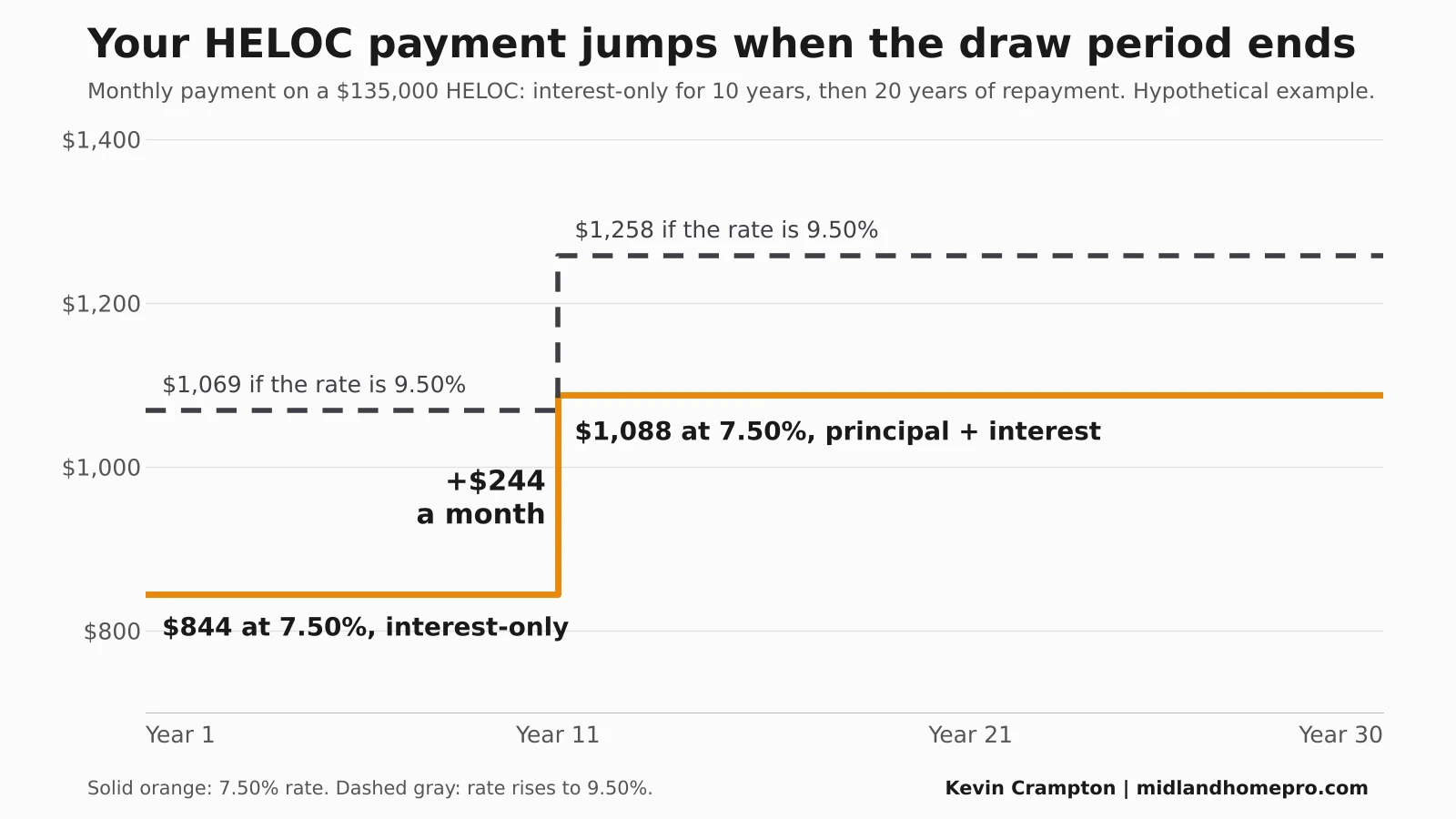
Watch year 11. When the draw period ends, the HELOC payment on $135,000 jumps from $844 to $1,088 at the same 7.50% rate, a $244 increase. At 9.50%, it goes from $1,069 to $1,258.
Look past the monthly payment. Over the first 10 years, at a steady 7.50% HELOC rate, the stay household pays about $143,300 in interest ($101,250 of it on the HELOC) and $53,000 in principal, all toward the first mortgage. The full $135,000 HELOC is still owed. The move household pays about $207,100 in interest and $41,200 in principal. After 10 years, the stay household owes about $247,000 combined and the move household owes about $261,200.
Treat any resale bump from the addition as uncertain. Whether it adds $100,000, $135,000, or less to market value depends on how well it fits the house and the street.
Step 4: Stress-test the answer
The quote comes in higher. At 20% over, $162,000, the full $150,000 line plus $12,000 from the reserve covers it, and the interest-only payment rises to $938. At 30% over, $175,500, the household is $5,250 short even after spending the whole reserve.
Rates rise. A HELOC tied to prime moves when prime moves. The Fed raised its target range to 3.75% to 4.00% on September 16, 2026 (Federal Reserve) and held it there on October 28 (Federal Reserve). Each one-point increase adds about $113 a month to the interest-only payment on $135,000. On the move side, rate risk ends at lock. A rate 0.50 higher, 7.78%, raises the new payment to $2,173.
The house still won’t work. If the real problem is the commute, the lot, or a floor plan that resists an addition, the lower payment buys a house that still falls short. That is the case where moving earns its higher cost.
Your checklist
Ask your lender:
- What is the maximum combined loan-to-value, and what line amount does that allow?
- Which index, what margin, and is the starting rate introductory?
- Is there a rate cap, and can I convert part of the balance to a fixed rate?
- How long are the draw and repayment periods, and what will my payment be when repayment starts?
- What fees apply to open, keep, or close the line early?
- If I move instead: what rate can I lock today, and for how long?
Ask your contractor:
- Is this a written, fixed-price quote, with every allowance listed?
- Who pulls the permits, and what is the timeline and payment schedule?
- Are you licensed and insured in Michigan?
Ask your real estate agent:
- What is my home worth today, and what would I likely net after selling costs?
- What does a home with the space I need cost, and what will its taxes be after uncapping?
- How would we time the sale and purchase?
Ask your tax professional: whether HELOC interest is deductible in your situation.
Start with your real numbers
The right answer depends on what your house is worth today and what you would walk away with if you sold. I’ll put together a current value estimate and a net proceeds sheet for your home, with no obligation to list. Reach me at kevin@modernrealty.us.
Request your Midland home value report
Kevin Crampton, Associate Broker, Modern Realty, Midland, Michigan.